
Skateboard Guide
Complete Buying Guide for Skateboards
There's no right or wrong when it comes to skateboarding. Everyone has different preferences, and that's okay. But we can provide some guidance on what to consider when choosing skateboard gear. If you're a novice, this skateboard buying guide is perfect for you. If you have any questions that aren't answered here, please feel free to call or email us, and we'll be happy to assist you.- Assemble Your Skateboard
- Skateboard Questions
- Complete Skateboards
- Skateboards for Kids
- Skateboard Deck
- Skateboard Trucks
- Skateboard Wheels
- Skateboard Bearings
- Griptape & Screws
- Skateboard Accessories
Skateboard Questions
Here, we answer our most common skateboarding questions. We hope you find answers to everything you're wondering about skateboarding. If you have any questions not covered in this buying guide, please don't hesitate to call or email us, and we'll assist you.
How do you assemble a skateboard?
Putting together your skateboard is easy. But if you're unsure how to do it, you can read our assembly guide HERE.
What width of skateboard should I have?
It's a matter of personal preference. But if you're an adult, 8" - 8.5" is a good guideline. Learn more about skateboard width HERE.
What are the best skateboards for kids?
For our narrowest boards, up to 7.75". Learn more about skateboards for kids HERE or purchase our kids' skateboards HERE.
How do you apply grip tape to a skateboard?
You can do it yourself easily. It's a useful skill to have. Watch the video below to see how it's done:
Grip tape is always included when you purchase a skateboard deck from us. Our complete skateboards come with grip tape already applied.
How do I know when it's time to replace my old skateboard with a new one?
When the skateboard feels "spongy" or when the nose and tail are worn out and sharp. That's when it's time to replace the deck.
What is the front and what is the back of a skateboard?
The front part is called the nose, and the rear part is called the tail. It can sometimes be challenging to tell which is the nose and which is the tail on a skateboard. Often, you can determine it by the graphics on the deck or some stamped text indicating the size of the board. You can also tell by sight—the tail is slightly shorter and steeper, while the nose is often larger and slightly rounder. Some skateboards are entirely symmetrical, with no difference between the front and back.
What wheel size is best for me?
It's a matter of preference and depends on the type of skateboarding you enjoy. Learn more about skateboard wheels HERE.
What truck size suits my board?
Different brands have different sizes. Check the size chart HERE or in the product description of the trucks.
What should I consider when buying bearings?
The ABEC scale is a good reference. BUT don't get too fixated on the ABEC scale. First and foremost, you need bearings that last. A high ABEC rating doesn't necessarily mean high quality. Learn more about bearings HERE. Keep in mind that bearings don't like rain, so try to avoid wet conditions, and don't leave your skateboard outdoors for extended periods. There's a risk of rain, and neither the deck nor the bearings like that.
I want to assemble all the parts for a skateboard; what do I need?
To put together all the parts for a complete skateboard, you'll need the skateboard deck itself (grip tape is always included when you buy a skateboard deck from us). You'll also need trucks that match the width of the deck (see size guide in the product description of the trucks), skate wheels in an appropriate size, bearings, and screws. So, you need five products: the deck (including grip tape), trucks, wheels, bearings, and screws.
Do I need any special tools to assemble a skateboard?
It's not mandatory, but a good skate tool/skateboard tool is always handy. Skateboard screws have a specific size, so regular wrenches or hex keys won't fit. That's why a skateboard tool can make assembly easier. Plus, it's convenient to have in your bag. You can find skateboard tools HERE.
When do I need Riser Pads for my skateboard?
You'll need Riser Pads when you're skateboarding and notice that the wheels hit the deck, or when you experience "wheel bite," as it's sometimes called. Riser Pads are flat plates that you place between the trucks and the deck to "raise" the deck. Up to 53mm wheels should be fine without Risers, but if you go over 54-55mm, it's a good idea to use Risers to avoid wheel bite. Learn more about Riser Pads below.
Complete Skateboard
A complete skateboard is the best option for those who are buying their first skateboard or aren't sure exactly which parts they want. Our complete skateboards are assembled with quality components that work well together. Additionally, buying a complete skateboard is more cost-effective. All complete skateboards come pre-assembled with the skateboard deck, trucks, bearings, wheels, and screws, so they are ready to ride right away. It's a good idea to purchase a skate tool for adjustments or part replacements when needed.
Skateboard Width
The width of a skateboard is measured in inches ("). The most common skateboard width for adults is 8" - 8.5". For kids, a narrower and shorter skateboard is preferable; read about skateboards for kids below. The skateboard width is largely a matter of personal preference and what you're used to. Some people prefer narrower skateboards for easier flip tricks, while others prefer wider boards for stability. Learn more about skateboard width HERE.
Skateboards for Children
For children, we recommend our narrowest complete skateboards. From the narrowest ones up to 7.75", it's usually a good width for children. A narrower board is easier for children to handle. Narrower boards are also shorter and lighter, making it easier to take the first ollie or kickflip. Recommending the exact width for a specific age is difficult. However, as a rough guide, for children who are 5 years old or younger, our narrowest boards up to 7.5" can be a good choice. For children aged 6-8 years, 7.5"-7.75" is usually suitable. For children 8 years or older, 7.75" or wider is a good width. But as mentioned, it's challenging as it depends on shoe size, weight, and skateboarding experience. If you're unsure about skateboard width, feel free to reach out, and we'll assist you.
| AGE | SKATEBOARD SIZE (WIDTH) |
| 5 years or younger | Our narrowest boards and up to 7.5" |
| 6-8 years | 7.5"-7.75" |
| 8 years and older | 7.75"+ |
Skateboard Width for Children: From our narrowest up to 7.75".
Skateboard Deck (Board)
The skateboard board itself is often referred to as a "deck." Boards are typically made of multiple layers of maple wood that are glued together to create a durable and poppy construction.
Width
Skateboard width is measured in inches ("). There is no right or wrong when it comes to skateboard width. Some prefer narrow boards, while others want the widest available. Trends also play a role in this. But boards from 8" to 8.5" are the most common skateboard widths for adults. A wider board provides stability and is great for ramps and bowls, while a narrower one is easier for flips and other tricks.
Skateboard Sizes by Shoe Size:
This is just a general guide for those buying their first skateboard. Skateboard width is highly individual, so it's not set in stone. However, the table below will help you get started. If you're looking for skateboard size for children, read HERE
| SHOE SIZE (EU) | SKATEBOARD SIZE (WIDTH) |
| 35-37 | 7.5" - 7.75" |
| 37-40 | 7.75" - 8.125" |
| 40-43 | 8.0 - 8.375" |
| 42-45 | 8.25" - 8.5" |
| 43-46 | 8.375" - 8.6" |
| 46+ | 8.5"+ |
General Guide to Skateboard Sizes:
Up to 7.75”
For children. Narrower skateboards are more manageable and fun for all little skaters.
7.75” - 8"
For youth or those who want a nimble board that's easier for flips and other tricks. Narrower skateboards are more manageable and enjoyable for those with smaller feet.
8” - 8.25”
The most common width and the sizes we sell the most of. Suitable for most riders. Great for street and skate parks.
8.25” - 8.5”
Great for park, mini-ramp, and bowl riding. A versatile option that works well everywhere. Also suitable for street skating if you prefer a slightly wider board.
8.5”+
Stable boards designed for transition skating like ramps, bowls, and skate parks.
Length
The length of skateboards is typically 28" to 32". Wider skateboards are usually longer, and narrower ones are shorter. Skateboard width is more important than length, so don't fixate on length unless you know exactly what board length you prefer.
Wheelbase
The wheelbase is the distance between the innermost mounting holes on the board. It determines how far apart the front and rear wheels are. Typically, wheelbase ranges from 13" to 15". A shorter wheelbase makes the board more maneuverable, while a longer one makes it more stable.
Concave
If you look at the top side of the board's length, you'll see that it's not flat. It has a concave shape, where the edges of the board are higher than the center. Skateboard concave is usually categorized as low, medium, or high. What you prefer for concave is like many other things, a matter of personal preference. Some prefer almost completely flat boards, while others like high concave for easier flip tricks.
Low Concave
Works well for mini-ramp, pool, and cruising. Low concave provides stability.
Medium Concave
The most common concave type and the one that suits most people. If you're not sure which concave you like, we recommend medium concave.
High Concave
The most aggressive type of concave. Ideal for technical tricks and street skating, as it provides more leverage on the high edges.
Shape
Shape refers to the board's form. The most common shape for skateboards is popsicle. It has a symmetrically rounded nose and tail and is considered the best shape. It allows you to perform tricks equally well on both ends and is excellent for flip tricks. We usually don't specify the shape's name in the product description because it's often clearly visible in the product image.
Front and Back/Nose and Tail
The front part of a skateboard is called the nose, and the rear is called the tail. Sometimes, it can be challenging to distinguish between the nose and tail of a skateboard, but often you can tell by looking at the graphics on the board. You can also tell by sight. The nose is often larger and slightly rounder, while the tail is shorter and steeper. A little tip is to make a small mark on the grip tape of the board to easily see what is the front and back. There are also completely symmetrical boards that are the same at both ends.
Grip tape is always included when purchasing a skateboard deck from us.
Skateboard Trucks
The trucks on the skateboard are what allow the board to turn. They consist of two simple metal parts: the baseplate that is mounted on the board and the hanger that has an axle where the wheels are attached. These two parts are connected by a bolt (kingpin) with rubber bushings in between. This is to ensure that the truck functions properly and provides smooth turns. Most truck brands have the same standard for screw size, nuts, and screw hole placement. This makes it easy to replace components that wear out. So when the wheels, bearings, or deck are worn out, you can easily replace them with others available in the market without having to buy a complete skateboard.
Size (Width)
Skateboard trucks are manufactured in various widths. The width of the trucks should match the width of your deck. Size guides for different brands can be found below or in the product description of the trucks.
Height (Low, Mid, High)
In addition to width, trucks are also categorized by height, typically as Low, Mid, and High. A low truck increases stability but decreases the turning ability of the board. A high truck allows for quicker turns but reduces stability.
Skateboard Truck Size Charts
Independent Size Guide:
| SIZE | AXLE | SKATE WIDTH |
| 109 | 6.9" | 6.2"-7.6" |
| 129 | 7.6" | 7.4"-7.8" |
| 139 | 8" | 7.8"-8.2" |
| 144 | 8.25" | 8.0"-8.5" |
| 149 | 8.5" | 8.25"-8.65" |
| 159 | 8.75" | 8.6"-9.0" |
| 169 | 9.125" | 8.9"-9.5" |
| 215 | 10" | 9.5"-10.5" |
Ace Size Guide:
| SIZE | AXLE | SKATE WIDTH |
| 22 | 7.75" | 7.5"-8.0" |
| 33 | 8.0" | 7.75"-8.125" |
| 44 | 8.25" | 8.125"-8.3" |
| 55 | 8.5" | 8.3"-8.75" |
| 60 | 8.75" | 8.6"-8.8" |
| 66 | 9.0" | 8.75"-9.25" |
| 77 | 9.5" | 9.25"-9.75" |
Krux Size Guide:
| SIZE | AXLE | SKATE WIDTH |
| 7.6 | 7.6" | 7.35"-7.85" |
| 8 | 8.0" | 7.75"-8.25" |
| 8.25 | 8.25" | 8.0"-8.5" |
| 8.5 | 8.5" | 8.25"-8.75" |
| 9 | 9.0" | 8.75"-10.40" |
Thunder Size Guide:
| SIZE | AXLE | SKATE WIDHT |
| 143 | 7.125" | -7,4" |
| 145 | 7.62" | 7.4"-7.9" |
| 147 | 8" | 7.9"-8.12" |
| 148 | 8.25" | 8.12"-8.38" |
| 149 | 8.5" | 8.38"-8.62" |
| 151 | 8.75" | 8.62"+ |
Venture Size Guide:
| SIZE | AXLE | SKATE WIDTH |
| 5.0 | 7.62" | -7,9" |
| 5.2 | 8.0" | 7.9"-8.1" |
| 5.6 | 8.25" | 8.1"-8.3" |
| 5.8 | 8.5" | 8.4"-8.6" |
| 6.1 | 8.75" | 8.62"+ |
Bullet Size Guide:
| SIZE | AXLE | SKATE WIDTH |
| 110 | 6.9" | 6.25"-7.6" |
| 120 | 7.2" | 7.4"-7.75" |
| 130 | 7.6" | 7.5"-7.75" |
| 140 | 8.0" | 7.75"-8.25" |
| 145 | 8.25" | 8.0"-8.5" |
| 150 | 8.5" | 8.25"-8.75" |
| 185 | 10.0" | 9.75+" |
Skateboard Wheels
Skateboard wheels come in a variety of sizes, hardness levels, colors, and designs. All our skateboard wheels are made of polyurethane, providing excellent grip and durability. Like most things in skateboarding, the type of wheels you choose is a matter of personal preference. Generally, smaller wheels are best for street skating, while larger wheels are more suitable for ramp, vert, and bowl riding. The two factors to consider when buying skateboard wheels are size and hardness. Read more about them below.
Wheel Size
Wheel size refers to the diameter of the wheels, and the most common sizes range from 50-54mm. Larger skateboard wheels are faster but less maneuverable, while smaller wheels accelerate quickly, are easier to handle but may not be as fast. Wheel size trends vary, and it largely depends on personal preferences. If you mainly skate street and skateparks, we recommend wheels in the 51-54mm range. If you prefer ramps and pools, you can look at wheels in the 54-60mm range. Keep in mind that larger wheels may require riser pads to create more space between the deck and the wheels to avoid wheel bite (when the wheel touches the deck when turning). The wheel's width and contact patch are also specified, but we won't delve into that as we consider the wheel's diameter to be the most crucial factor to consider. If you're not too picky and don't know the exact width and contact patch you want.
Hardness
Skateboard wheel hardness is measured in durometer and is indicated by numbers followed by the letters A or B for the hardest wheels. Personal preferences play a significant role in what hardness you like, so it varies. The most common hardness for street skating is around duro 101, while for ramp and bowl riding, it's around duro 99, but it's a matter of personal taste. Hardness affects grip and shock absorption. A soft wheel provides good grip but rolls slightly slower, while a hard wheel grips less but rolls faster on smooth surfaces.
Skateboard Bearings
Bearings are what make the wheels on a skateboard spin. Each wheel requires two bearings, so a skateboard needs a total of 8 bearings. Bearings are always sold in packs of 8. Bearings consist of an inner and an outer raceway that can rotate freely relative to each other, thanks to balls positioned between the raceways and held in place by a cage. Bearings have shields made of rubber or metal that enclose the sides of the bearing and protect against dirt and dust. The raceways are typically made of steel, but there are exclusive variants made of ceramics. The cage that holds the balls is usually made of steel or nylon. Bearings with nylon cages are better suited for higher speeds because nylon has lower friction, resulting in less heat and less wear. Keep in mind that bearings don't like rain, so try to avoid rain and puddles. Also, avoid leaving the board outdoors for extended periods; if it rains, both the deck and the bearings can be damaged.
ABEC
ABEC is a standard that represents the tolerance and precision of bearings. Bearings graded with the ABEC system are often referred to as "precision bearings" and are graded on a scale with numbers 1, 3, 5, 7, and 9. Higher numbers indicate better standard precision.
First and foremost, you need bearings that last. The most common mistake people make when choosing bearings is selecting the highest possible ABEC rating, regardless of how they use their skateboard. For example, for street skaters, a lower ABEC rating is probably sufficient, as they rarely need the speed that an ABEC-7 or 9 offers. As mentioned, the most important thing is bearings that endure. There are no requirements for the material of the bearing; they just need to be made to a certain degree of precision. A high ABEC rating doesn't necessarily equate to high quality. How well a bearing rolls depends on factors other than just the ABEC rating. It also depends on the lubrication, how the balls are seated, as well as other factors like steel quality and material choice.
SKF Bearings
SKF or Svenska Kullager Fabriken is a brand that is very dear to us, not only because it's a Gothenburg-based company but also because of their premium skateboard bearings, which are of the highest quality. SKF is a market leader in bearings in the industry, so we dare say they are the best in the world when it comes to bearings. SKF's bearings are designed to withstand tough skate conditions, meaning they can handle high speeds and significant stress on all types of surfaces.
Bones Bearings
Bones Bearings is one of the most renowned bearing manufacturers for skateboarding. Bones bearings are not rated on the ABEC scale, but their precision is equivalent to an ABEC-3 or 5, which is perfect for skateboarding. Bones Bearings is one of the most appreciated bearing brands among skateboarders.
Cleaning
Unfortunately, the precision of your bearings deteriorates over time, so how long they last and how well they roll depend largely on how and whether you maintain them. Some bearings are easy to maintain, while others are virtually impossible. Bearings with completely sealed metal shields are impossible to maintain, while those with a single metal shield are relatively easy to clean and lubricate. Bearings with rubber shields are the easiest to maintain. They are easy to clean thoroughly and then lubricate.
Griptape & Screws
Griptape
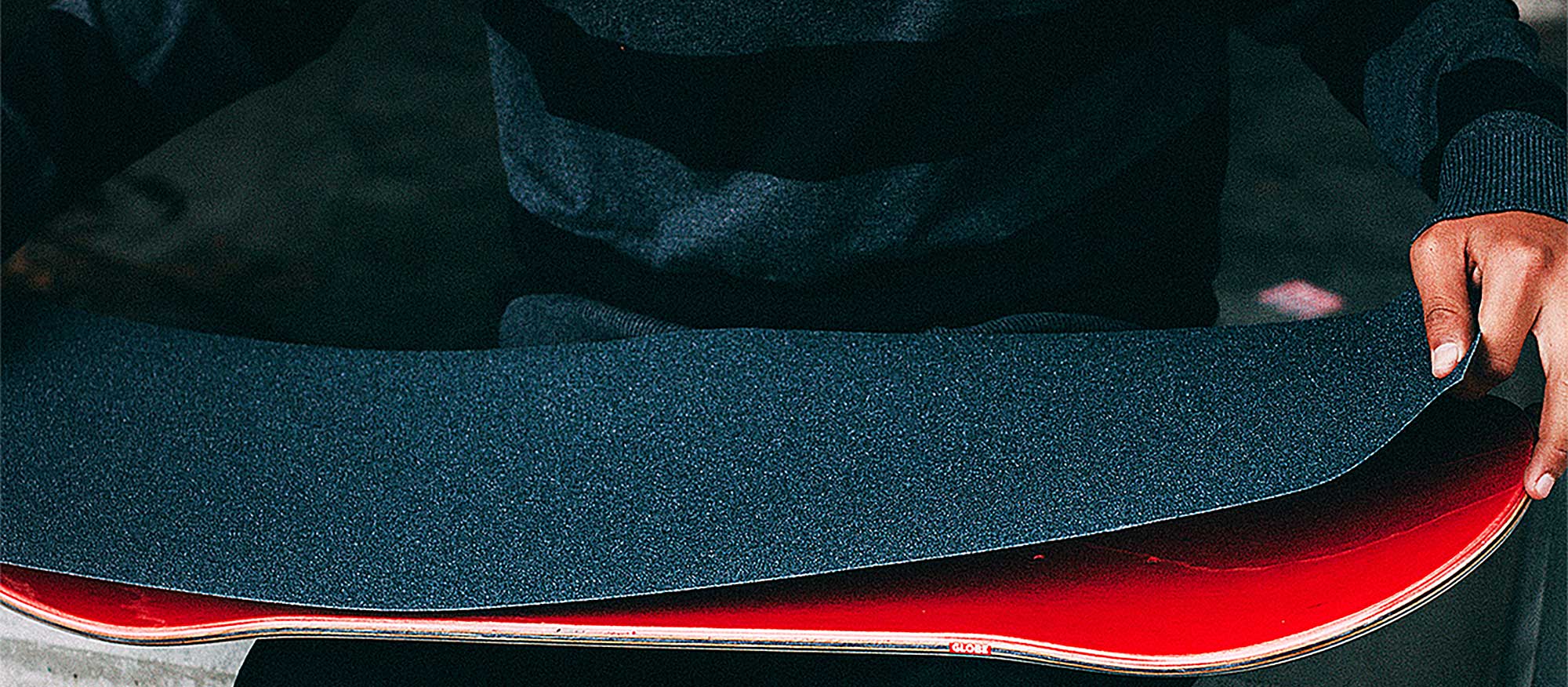
Griptape is a self-adhesive sheet that closely resembles sandpaper. It is applied to the top side of the skateboard to provide better grip for your feet. Griptape is a must-have for your skateboard. Be careful and precise when applying new griptape to your board to avoid air bubbles. Some griptapes (MOB griptape) also have small, almost invisible holes for easy and bubble-free application. At Stand Tall, we sell high-quality griptapes like MOB griptape and Jessup griptape. - Griptape is always included when you purchase a skateboard deck from us.
See how to apply griptape on a skateboard (video):
Screws
The board and trucks are fastened together with screws and nuts. There are different lengths of screws, but the standard length is 7/8" or 1". 7/8" screws are suitable for a standard setup, but if you have riser pads, you'll need 1" screws or longer. Read more about riser pads below.
Screws come in different colors and with different heads, either for a Phillips screwdriver or an Allen key. Keep in mind that the Allen key size is in inches, so it might be a good idea to purchase a skate tool.
Riser Pads
When skateboarding and you notice that the wheels touch the board or experience "wheelbite," it can be a good idea to use riser pads. Riser pads are plates that you place between the trucks and the board to "raise" the board, creating more space between the wheels and the board. Riser pads come in various sizes, and you'll need to gauge how high they should be relative to your wheel size and the type of riding you do. If you're unsure, you can start with the smallest ones and then build up if you need more distance between the trucks and the wheels.
Up to 53mm wheels, you usually don't need riser pads, but if you go over 54-55mm, it's a good idea to use riser pads to avoid wheelbite. See the table below for screw length and riser pads relative to wheel size.
Depending on the thickness of the riser pads you choose, you'll also need to select the right screw length.
See the table below:
Just a general table as it also depends on how high your trucks are and whether you ride soft or hard trucks.
| WHEEL SIZE | SCREW LENGTH | RISER PADS |
| 49-54 mm | 7/8"-1" | No riser pads |
| 55-58 mm | 1"-1 1/8" | 1/8" riser pads |
| 58-62 mm | 1 1/4" | 1/4" riser pads |
| 62-68 mm | 1 1/2" | 1/2" riser pads |
Skateboard Accessories
Skate Tool
A skateboard accessory that's a must-have is a skate tool. It will be your best friend when assembling a skateboard. A skate tool has all the keys you need to put together a skateboard and is almost a necessity.
Helmet & Protection
A good helmet is important. All children MUST wear a helmet, but adult skateboarders should also protect their heads. Knee pads, elbow pads, and wrist guards can also be your saviors when a crash happens.